I am sharing a policy framework and supporting documents to help inform the public conversation about data center growth. I have also listed policy recommendations for transparency, accountability, infrastructure planning, community benefit, and responsible digital infrastructure growth.
These documents reflect my personal perspective as one member of the Hillsboro City Council and are intended to support public understanding and policy discussion.
Why Now?
Hillsboro is entering a new phase of data center growth, and residents deserve clear information about how that growth affects land use, infrastructure, utility demand, tax incentives, and long-term public benefit. With multiple data center sites already constructed, under construction, or in permitting, and with recent Enterprise Zone applications raising new questions about transparency and accountability, now is the right time to review whether our policies are keeping pace with the scale of development. The goal is not to stop innovation, but to make sure growth is planned responsibly, communicated clearly, and structured to deliver lasting value for the whole community.
Key Recommendations
My policy framework focuses on transparency, accountability, community benefit, livability, and environmental sustainability.
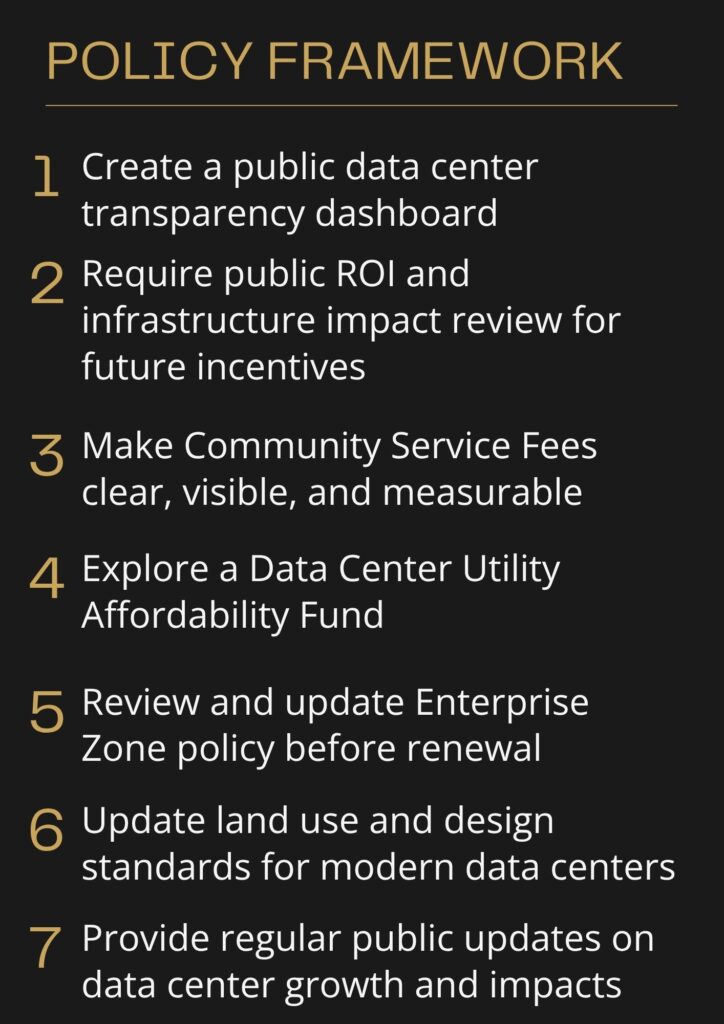
Key Findings
Note: I put these graphs together to help me understand the impact over time of the different data points are public to us. Several figures include illustrative trend modeling derived from publicly available utility, infrastructure, and economic development sources. Certain visualizations are intended to demonstrate regional trend relationships and should not be interpreted as audited utility forecasting models.
Enterprise Zone Tax Revenue Impact (QTS Case Study)
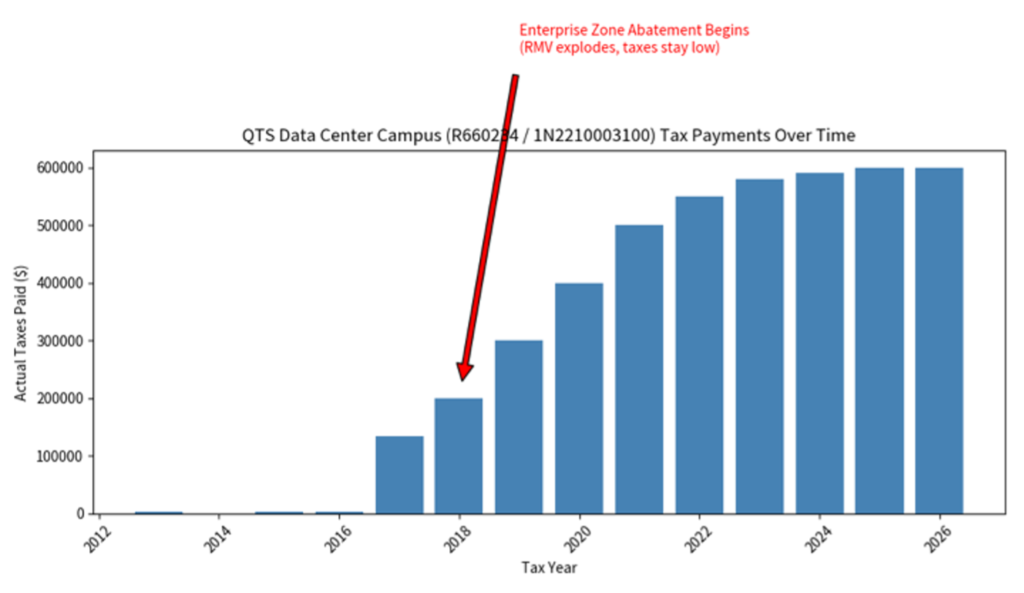
The QTS Hillsboro 1 campus (Tax Lot 1N2210003100) offers us a useful case study to explore how Enterprise Zone helps bring in investments.The Washington County public tax record shows total taxes billed of $3,612.59 after discount in 2017, before QTS Investment Properties Hillsboro LLC became the listed owner, and $599,840.72 in 2025 after the property was developed (Washington County Assessment).
Data Center Growth Impact on Residential Electricity Rates
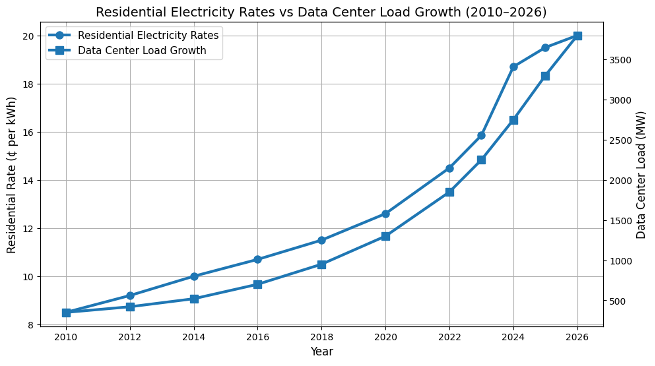
The graph shows the comparison between PGE residential electricity rate growth and electricity demand growth between 2010 – 2026. It’s important to understand that correlation doesn’t always equal causation but in this case it is hard to ignore what I am seeing. It seems much of the cost of grid upgrades was socialized across all ratepayers, contributing to higher electricity bills for residential and small business customers. This effectively created a cross-subsidy from households and local businesses to large data center operators.
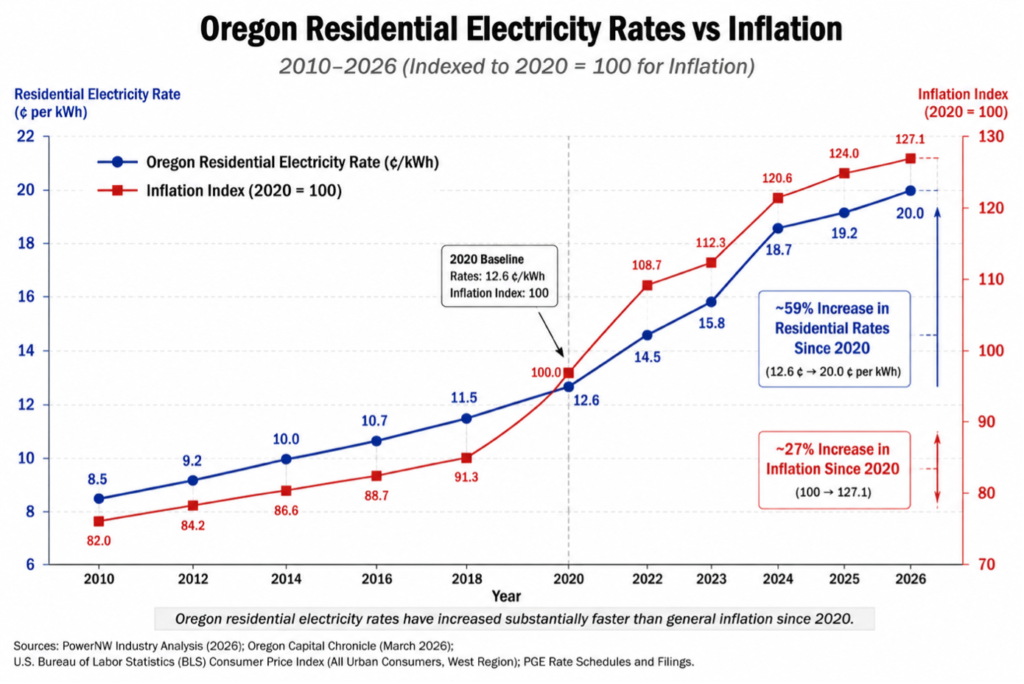
This graph shows how electricity rates have grown compared to the inflation index. The inflation index measures the change of price in goods and services over time. PGE has repeatedly argued with state regulators that inflation is a primary driver behind rising energy bills for residents due to a rise in fuel, grid maintenance, and market power purchases.According to industry analysis and regional reporting, average PGE residential electricity rates increased from approximately 12.6¢ per kWh in 2020 to roughly 20¢ per kWh by 2026 — an increase of approximately 59% over six years. By comparison, overall inflation during the same period was substantially lower. While utility rate increases are influenced by multiple factors. The timing of rate increases coincides with a significant expansion in large industrial electrical loads, including rapid data center growth.
Looking Forward
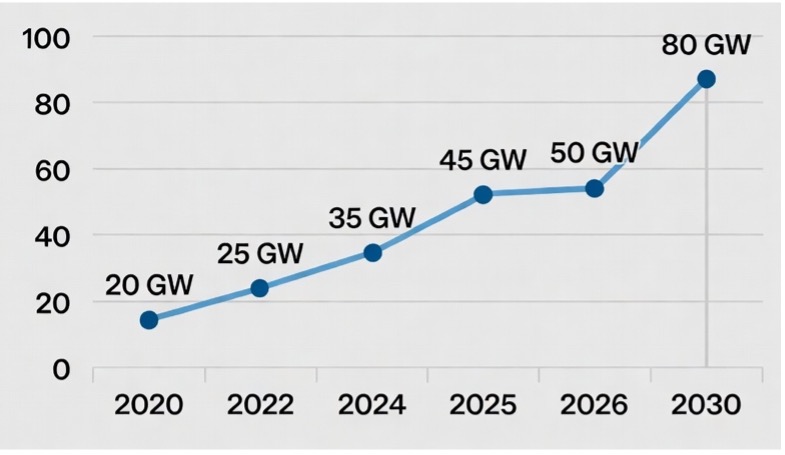
U.S. data center capacity has grown significantly, with projections indicating continued expansion driven by digital infrastructure demand (Approximate data synthesized from CBRE, JLL, and industry reports). Hillsboro is one of the Pacific Northwest’s largest concentrations of digital infrastructure investment and has led global leading technology development.
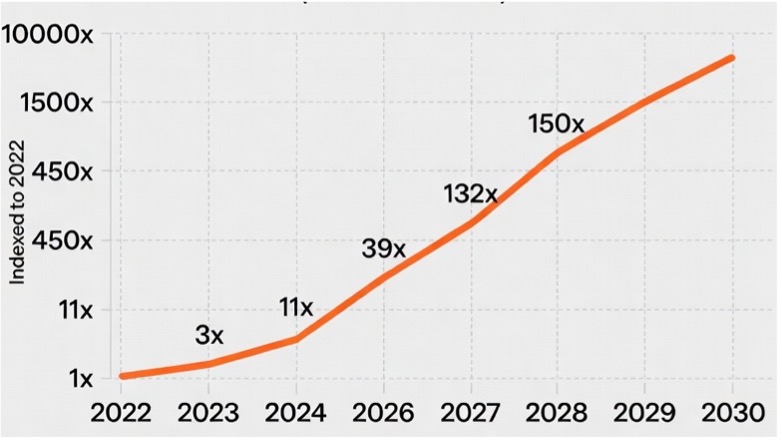
This graph is predicting Global AI Compute Capacity Growth, indexed to 2022. The total installed base of AI computing hardware has grown exponentially, roughly doubling every 7 months since 2022 (Source: Epoch AI). The rapid expansion of AI, cloud computing, automation, and digital services has driven a sharp increase in national demand for data centers. As companies accelerate digital infrastructure buildout, communities nationwide are facing growing strains on energy systems, industrial land availability, water resources, and overall infrastructure planning.
Why This Matters for Hillsboro Residents
These findings point to a simple but important responsibility: Hillsboro must make sure the growth of digital infrastructure does not leave residents carrying more of the cost.
Data centers have brought important private investment, construction activity, and tax revenue to our community. But their rapid growth has also placed significant pressure on our electric grid, requiring infrastructure investments that can show up in higher utility costs for households and small businesses.
Responsible growth means recognizing both sides of that equation. As Hillsboro continues to support innovation and economic development, we should also take practical steps to reduce the financial impact on residents. One way to do that is by exploring a Data Center Utility Affordability Fund supported through future data center-related revenues, community service fees, or other appropriate mechanisms.
The goal is not to stop growth. The goal is to make sure growth pays its fair share, protects long-term livability, and delivers real benefit to the people who call Hillsboro home.
Policy Documents
| Main Policy Framework | Recommendations for responsible data center growth in Hillsboro. | Download PDF |
| Attachment A: Enterprise Zone Case Study | Case study explaining how the Enterprise Zone program works in practice. | Download PDF |
| Attachment B | Supporting document, coming soon. | Coming Soon |
| Full Policy Packet | All documents combined into one PDF. | Download PDF |
Upcoming Work Session
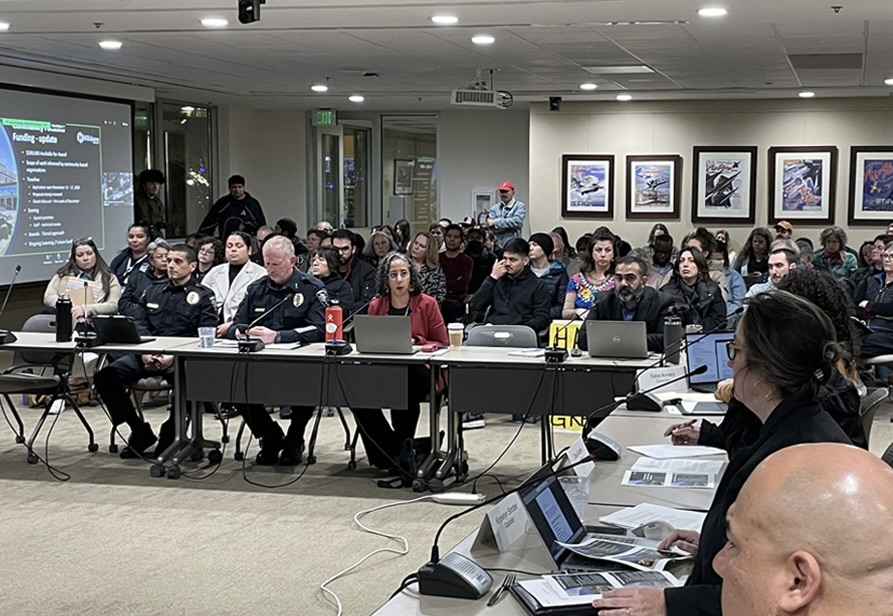
Hillsboro City Council Work Session – Data Centers
6:00 PM – 9:30 PM
Special Work Session to Discuss Future of Data Centers and E Zones